Petite Planet: Check it out! Baby steps toward changing the world!! AND IT'S ALL BABY STEPS, RIGHT MICHAEL MERVOSH!!! HERO'S JOURNEY FOUNDATION!!!! SEE THEM TOO
Bruce W Sargent
CEO http://www.forloveofyurts.com
Wednesday, January 20, 2010

Tuesday, January 19, 2010
IF IT'S NOT FUN, I'M NOT DOING IT!

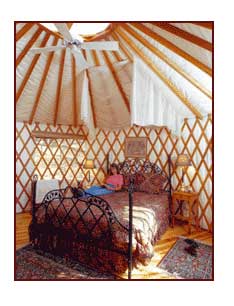
"If it's not fun, I'm not doing it!" Sometimes I get so serious, passionate and intense about things that I forget, that yurting is just plain fun. I found an Australian website that reminded me about what life's about: http://goglamourcamping.com/ Check them out. Most likely you are going to smile. :-) We are calling it "glamping" or "glamour camping".
Bruce Sargent
http://www.forloveofyurts.com
Friday, January 15, 2010
MUST SEE POST BY FRIENDS AT COLORADO YURTS
Monday, January 11, 2010
Response to NYTimes, "Broadband, Yes. Toilet, No": Why not have both?
You may have already seen Sarah Maslin Nir’s New York Times article “Broadband, Yes. Toilet, No” (12/30/09) about an adventurous couple that moved their young family to a yurt in rural Alaska. The Higman-McKittricks are an inspiring example of a wave of folks who are moving to yurts, making nature a part of their everyday lives-- not just a holiday treat-- and staying connected to a broader community through the internet. It’s Back to the Land 2.0!
From a yurt-dweller’s perspective there are some great points in the article: I loved the concept that the amount of living space in a yurt expands and contracts based on need at any given moment. I also liked the fact that they have internet in the yurt-- this allows them to connect all the diverse bits of their lives, remain active, stay in touch, and get written up in the New York Times.
But, by focusing on this one couple, the article doesn't give the full picture of the yurt-living experience. Toward the end of the article Ms. McKittrick is quoted as having said, “I’m someone who doesn’t mind giving up some level of convenience for having an interesting experience.” Many bloggers found the story to be inspiring but said that the couple sacrificed more than is reasonable for your average NYTimes reader. The worst part? The frigid trek from the yurt to the outhouse. I can't argue with that. This begs the question: Is sacrificing convenience a pre-requisite for yurt living? Most definitely not.
There are plenty of good options for putting a bathroom right inside your yurt, even if you’re off the grid. Below are a couple of toilet possibilities that our customers have used with great results:
The Incinolet toilet is a good option for folks who are hooked into electricity, either from a power plant or solar. The toilet requires no digging and no water. It works by periodically incinerating waste, so all that's left is a small amount of clean ash. Below is a picture of our customer, David Stewart’s Inciolet:

One of my favorite toilet options (for homes of all kinds!) is the Sun Mar composting toilet. Sun Mar makes a couple of models-- some require electricity, some don’t. These toilets are self-contained and compact. Installing a composter in your yurt is as simple as fitting an outlet, similar to a stovepipe outlet, into the yurt wall. They are odorless and produce fertilizer that can be used in growing non-edible plants. The Colorado Yurt Company is now a Sun Mar distributor, so give us a call at 1.800.288.3190 if you’d like any information or to place an order.
Perhaps the simplest and most rugged option (but still a far cry from an icy outhouse) is the do-it-yourself composting toilet. These toilets are as cheap as $25. They require little more than a 20 liter bucket, a box to house it in, a seat, and organic material, such as sawdust, to aid in the composting process. The waste from these toilets is also processed into fertilizer. The only problem with these toilets is that you have to figure out a way to protect against freezing. Click here to read about this type of toilet at the Humanure Handbook. Here is an instructional youtube video on making such toilets by the folks out of Pennsylvania that make the "Loveable Loo."
This lovely bathroom with a homemade composter is in Everett Boutilett and Louis Johnson's Colorado Yurt in upstate New York:

All of these toilets can be installed in a yurt bathroom, which is built by constructing a few walls inside the yurt. The yurt WC pictured below is a literal closet but without the water:

By adding an energy efficient toilet, like one of these, to a yurt, you can have the “experience” without sacrificing a shred of "convenience." No subzero dashes to the outhouse for me!
Other parts of the Higman-McKittrick yurt experience struck me as not necessarily representative (albeit cool). For example, the fact that they have to walk an hour to town to take a shower. Even yurt-dwellers without grid-based plumbing find all kinds of creative ways to have plenty of water right in their yurt, but that's a subject for another post.
Happy New Year,
Sam Kigar
From a yurt-dweller’s perspective there are some great points in the article: I loved the concept that the amount of living space in a yurt expands and contracts based on need at any given moment. I also liked the fact that they have internet in the yurt-- this allows them to connect all the diverse bits of their lives, remain active, stay in touch, and get written up in the New York Times.
But, by focusing on this one couple, the article doesn't give the full picture of the yurt-living experience. Toward the end of the article Ms. McKittrick is quoted as having said, “I’m someone who doesn’t mind giving up some level of convenience for having an interesting experience.” Many bloggers found the story to be inspiring but said that the couple sacrificed more than is reasonable for your average NYTimes reader. The worst part? The frigid trek from the yurt to the outhouse. I can't argue with that. This begs the question: Is sacrificing convenience a pre-requisite for yurt living? Most definitely not.
There are plenty of good options for putting a bathroom right inside your yurt, even if you’re off the grid. Below are a couple of toilet possibilities that our customers have used with great results:
The Incinolet toilet is a good option for folks who are hooked into electricity, either from a power plant or solar. The toilet requires no digging and no water. It works by periodically incinerating waste, so all that's left is a small amount of clean ash. Below is a picture of our customer, David Stewart’s Inciolet:

One of my favorite toilet options (for homes of all kinds!) is the Sun Mar composting toilet. Sun Mar makes a couple of models-- some require electricity, some don’t. These toilets are self-contained and compact. Installing a composter in your yurt is as simple as fitting an outlet, similar to a stovepipe outlet, into the yurt wall. They are odorless and produce fertilizer that can be used in growing non-edible plants. The Colorado Yurt Company is now a Sun Mar distributor, so give us a call at 1.800.288.3190 if you’d like any information or to place an order.
Perhaps the simplest and most rugged option (but still a far cry from an icy outhouse) is the do-it-yourself composting toilet. These toilets are as cheap as $25. They require little more than a 20 liter bucket, a box to house it in, a seat, and organic material, such as sawdust, to aid in the composting process. The waste from these toilets is also processed into fertilizer. The only problem with these toilets is that you have to figure out a way to protect against freezing. Click here to read about this type of toilet at the Humanure Handbook. Here is an instructional youtube video on making such toilets by the folks out of Pennsylvania that make the "Loveable Loo."
This lovely bathroom with a homemade composter is in Everett Boutilett and Louis Johnson's Colorado Yurt in upstate New York:

All of these toilets can be installed in a yurt bathroom, which is built by constructing a few walls inside the yurt. The yurt WC pictured below is a literal closet but without the water:

By adding an energy efficient toilet, like one of these, to a yurt, you can have the “experience” without sacrificing a shred of "convenience." No subzero dashes to the outhouse for me!
Other parts of the Higman-McKittrick yurt experience struck me as not necessarily representative (albeit cool). For example, the fact that they have to walk an hour to town to take a shower. Even yurt-dwellers without grid-based plumbing find all kinds of creative ways to have plenty of water right in their yurt, but that's a subject for another post.
Happy New Year,
Sam Kigar


Ultra Simple Solutions for Haitian Disaster
Emergency plans for water, sanitation and housing for Haiti might look like this:
Water Filter from Top to Bottom"
Water Filter from Top to Bottom"
- Unfiltered water
- Sand
- Charcoal
- Gravel
- Spout and collector for filtered water
- Boil filtered water at a rolling boil for 3 to 20 minutes
- Heap currently being added to, containing waste, leaves, grass clippings, sawdust
- Heap resting and sanitizing for a full year
- Heap that has sanitized for a full year and is now being used in gardens
- Rectangular earth or sand bag walls, covered with tarps and a few wood rafters.
- Yurt style, circular, earth or sand bag walls, covered with tarps and rafters, with yurt style roof.
- Ultra simple yurts: see http://www.forloveofyurts.com
Radio Broadcast on Yurt Building and Yurt Living

I will appear on a radio show, Definitely Dance this coming Sunday, January 17th, at 9 AM EST broadcast from WSBS.COM 91,4 FM. The show's theme is about living from passion, hence the life worth living definitely dances. The book For Love of Yurts, Building an Ultra Simple Yurt Home for Under a $1000, is now on sale in Great Barrington, Massachusetts, at Crystal Essence, 39 Railroad Street. The show can be heard at WSBS.com and eventually here, at http://www.forloveofyurts.blogspot.com.
Tuesday, January 5, 2010
Yurts: Housing For The Coming Hard Times
A yurt is a structure that can be home built for roughly one-tenth the cost of a yurt kit. Yurt kits create space at $40 a square foot for a sixteen foot diameter/two hundred square foot yurt. A home built yurt of the same size creates space at $4 a square foot. In a depressed economy, a home built yurt may be the only way to have independent housing for some people. (Check out www.forloveofyurts.com to see how this can be done).
Building the yurt only solves part of the housing problem. The problem of where to put the structure will be key in creating a yurt home. One possibility is to put the yurt up in a friend's or relative's backyard. Because the structure in temporary, essentially a camping tent, the yurt might not fall under the jurisdiction of the town building inspector. You need to check carefully with local officials before putting your yurt up to make sure you are not bringing difficulties to your friend or relative. One advantage to a backyard placement is that the bathroom facilities and kitchen facilities might be available to the yurt dweller. The yurt serves essentially a living room, office and bedroom in this case. Depending on your relationship with your friend or relative, you become a part of their life in using the "big house" or you might schedule bathroom visits in the early morning to use the big house bathroom for a short time to empty a camp toilet and fill a water jug, never crossing paths with your host or hostess. Because the yurt comes down and is relatively easy to move, your friend or relative can be assured that the situation is truly temporary.
Another possible site for a yurt is a campground. A campground has the advantage of having bathing facilities, a water source and even electricity available to a yurt dweller. The disadvantage of campgrounds is that they are often seasonal and the often have campsites so jammed packed that there is virtually no privacy. Because yurts are not sound proof you will be living within your neighbors outdoor conversations and they will be living within your indoor conversations. You will have absolutely no privacy whatsoever. Some campground owners will allow you to pitch your yurt away from the jammed packed sites in an out of the way section of the park, but many parks are unable to provide this.
The best place to site a yurt is on your own rural land. Not everyone is in a position to do this and it may take collective efforts of groups of friends or relatives to manage this. Yet homesteading may be the only way to accomplish a productive life in the coming hard times. Visit Homestead Basics to see how.
Building the yurt only solves part of the housing problem. The problem of where to put the structure will be key in creating a yurt home. One possibility is to put the yurt up in a friend's or relative's backyard. Because the structure in temporary, essentially a camping tent, the yurt might not fall under the jurisdiction of the town building inspector. You need to check carefully with local officials before putting your yurt up to make sure you are not bringing difficulties to your friend or relative. One advantage to a backyard placement is that the bathroom facilities and kitchen facilities might be available to the yurt dweller. The yurt serves essentially a living room, office and bedroom in this case. Depending on your relationship with your friend or relative, you become a part of their life in using the "big house" or you might schedule bathroom visits in the early morning to use the big house bathroom for a short time to empty a camp toilet and fill a water jug, never crossing paths with your host or hostess. Because the yurt comes down and is relatively easy to move, your friend or relative can be assured that the situation is truly temporary.
Another possible site for a yurt is a campground. A campground has the advantage of having bathing facilities, a water source and even electricity available to a yurt dweller. The disadvantage of campgrounds is that they are often seasonal and the often have campsites so jammed packed that there is virtually no privacy. Because yurts are not sound proof you will be living within your neighbors outdoor conversations and they will be living within your indoor conversations. You will have absolutely no privacy whatsoever. Some campground owners will allow you to pitch your yurt away from the jammed packed sites in an out of the way section of the park, but many parks are unable to provide this.
The best place to site a yurt is on your own rural land. Not everyone is in a position to do this and it may take collective efforts of groups of friends or relatives to manage this. Yet homesteading may be the only way to accomplish a productive life in the coming hard times. Visit Homestead Basics to see how.
Subscribe to:
Posts (Atom)


